



.jpg)

Maison Asrar Belgravia Eau de Parfum - Unisex Perfume
Bright bergamot and lemon lead Belgravia towards gentle florals, subtle caramel and a woody-musky finish. See more
Belgravia from Maison Asrar: a bright first impression, a less predictable finish
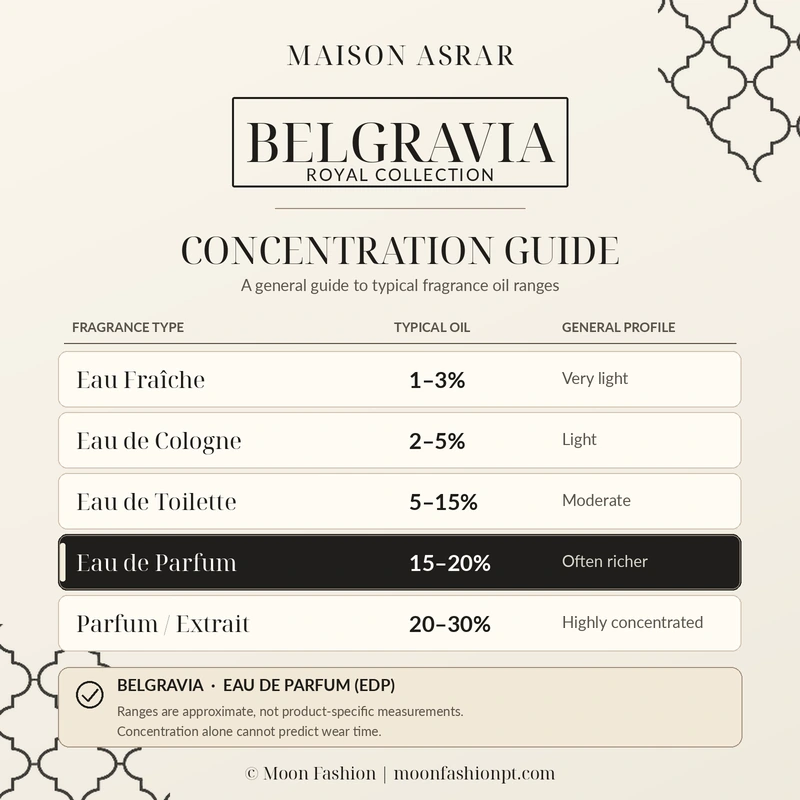
Maison Asrar Belgravia is a unisex Eau de Parfum in the Royal Collection. It begins with a bright fruit-citrus impression, moves towards a softer floral centre and settles into woody-musk territory. The change matters because a perfume you enjoy at first spray may not be the one you remember at the end.
Think of it as citrus freshness with a softer, slightly sweet middle and a woody-musky foundation, rather than as a straightforward lemon fragrance. Wearer descriptions often mention a creamy or clean impression after the opening. They also disagree about how sharp the beginning feels and whether the finish is mainly soft musk or drier wood.
Main Accords
Citrus
Two official top notes, bergamot and lemon, give Belgravia its brighter character. The citrus label describes that shared impression; it does not say how much citrus material is in the formula or how long it remains noticeable.
Woody
Sandalwood appears in the heart, followed in the official base by cedarwood and vetiver. The resulting woody impression can seem softer during the transition and relatively dry later, especially to wearers who notice moss more than musk.
Fruity
Blackcurrant adds a different reference to the bergamot-lemon opening. It helps account for accounts of a rounded or fruit-sweet first impression, but it is not evidence of a syrupy berry accord dominating every wear.
Aromatic
This specialist accord captures an aspect of the overall fresh, structured character. It should not be mistaken for an undisclosed herbal note or an ingredients declaration: the brand's official pyramid remains the reference for named notes.
Floral
Lily of the valley and freesia occupy the heart, creating a potential bridge between the citrus opening and the more rounded sandalwood-caramel combination. This need not mean a heady, densely floral perfume.
Powdery
A slightly powdery, clean-textured finish appears in some direct wearer descriptions. Others notice earthier woods. Powdery is a perceptual category here, not a statement that talc is an ingredient.
Musky
Musk is a named base note and a plausible link to the clean, close-wearing softness that some people describe after the florals settle. Its prominence varies in reports alongside cedarwood, moss and vetiver.
Caramel
Caramel is listed in the heart and occurs in a recent specialist accord snapshot. The perceived strength of that sweetness is disputed: some wearers describe a distinct sweet touch; others recognise mainly a creamy rounding of flowers and wood.
The accord profile connects three impressions: citrus and fruit at the entrance, floral softness through the centre, and a woody-musky finish. The caramel facet may take the edge off the brighter opening; a powdery quality can make the later stage seem cleaner than the earthy notes suggest. These are ways of describing the scent, not a second manufacturer note list.
The first spray: when sharp citrus meets darker fruit
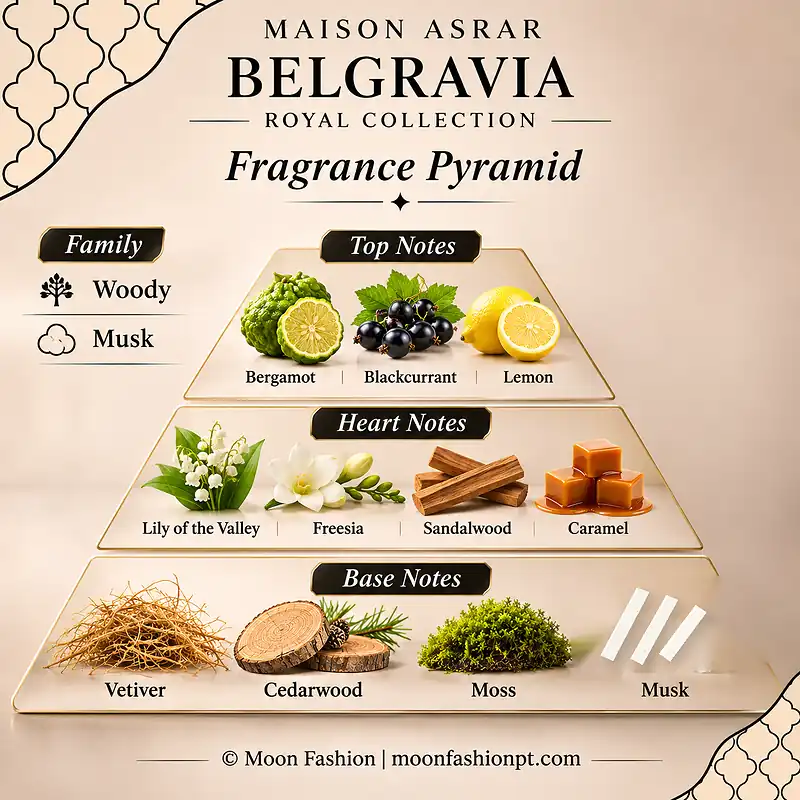
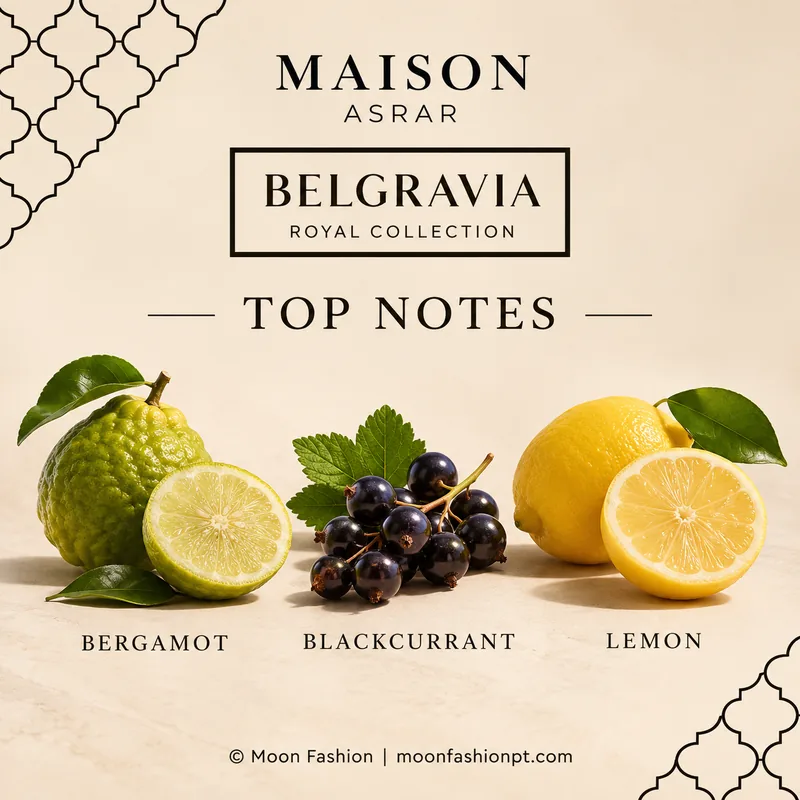
Top Notes — Bergamot, Blackcurrant, Lemon
Bergamot and lemon share a bright citrus direction, while blackcurrant provides a fruitier counterpoint. Their coexistence explains why a first impression may feel simultaneously brisk and slightly rounded. Belgravia does not need a fourth, unlisted fruit to make that contrast plausible.
Not harsh opening, smooth from the start— a firsthand Belgravia review on Fragrantica.
Another firsthand reviewer described the opening more critically; the experiences genuinely differ.
How do I separate citrus brightness from an uncomfortable opening?
Ask whether you dislike the character or simply the intensity of what you smell first. A bright bergamot-lemon impression can be enjoyable even when pronounced; a sharp quality that you find unpleasant is a different matter. Direct reviews point in both directions, so the official note pyramid cannot answer this preference question on its own.
Do not assume that waiting a fixed number of minutes will always solve a disliked opening. Some wearers report a substantial change as Belgravia settles; others maintain reservations about the scent. If a first spray is a deal-breaker for you, testing it across more than one stage provides a more useful answer than a universal timing claim.
Is blackcurrant the same as a jammy berry accord here?
No such equivalence follows from the official note. In this composition blackcurrant sits between two explicitly citrus notes. It can suggest fruit-sweet depth or soften the impression of acidity without creating an unmistakable blackcurrant preserve. If dark, juicy berries are your main purchasing criterion, you should not infer that result merely from seeing the note.
Equally, a citrus-led description does not erase blackcurrant. The point is the contrast between a fresh outer edge and a fuller fruit reference. That contrast helps distinguish Belgravia's opening from a generic description that only says “fresh and lively”.
The middle is where sweetness changes its meaning
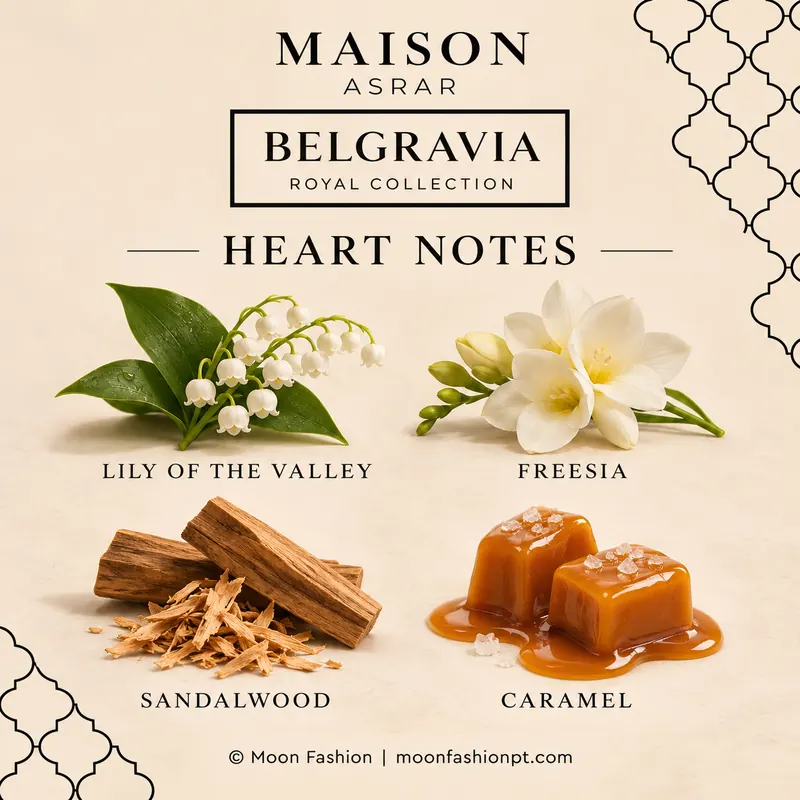
Heart Notes — Lily of the Valley, Freesia, Sandalwood, Caramel
Belgravia places two floral notes next to sandalwood and caramel. This is more revealing than any of the four names alone. Lily of the valley and freesia offer a lighter floral reference; sandalwood can give the middle a more rounded woody direction; caramel brings a potentially sweet accent.
How sweet is the caramel once the citrus quietens?
This is one of the most divided points in the available experiences. Some wearers clearly identify a sweet, almost gourmand warmth; others say the caramel remains understated and mainly alters the texture of the florals. Belgravia therefore asks for a specific distinction: enjoying a sweet accent is not the same as wanting an unmistakably edible caramel perfume.
The placement of caramel within the heart is also significant. It is not the only top note setting the first impression, and it is not the sole constituent of the base. A shopper choosing primarily for confectionery sweetness could find the initial lemon-bergamot brightness or later moss-vetiver dryness more prominent than expected.
Conversely, someone who avoids sugary fragrances might find that a restrained caramel effect provides just enough warmth beside flowers and sandalwood. The note should inform a question worth testing, not settle that question automatically.
Do the white flowers dominate, or help connect the stages?
The official heart gives both lily of the valley and freesia a place, but it does not tell us that either flower must be independently recognisable throughout wear. Their joint role can be understood as a lighter centre between fruit-citrus and wood-musk impressions. A strong white-flower bouquet is not established merely by having two flowers in the note list.
Think about what the flowers contribute to your own preference: do they add the delicacy you want after the brighter start, or do you prefer a fragrance that keeps the citrus front and centre? This is more discriminating than assuming every fragrance with freesia is similar. It also explains why the middle may feel soft without becoming traditionally powdery for everyone.
Why is sandalwood in the heart rather than only the base?
Here sandalwood supplies an early woody reference before the official base introduces vetiver, cedarwood and moss. It can be read as a bridge between the smoother middle and a comparatively drier later impression. This is an interpretation of the published structure rather than a formula-level claim about what evaporates first.
It also guards against a common misunderstanding: Belgravia does not suddenly become a different perfume when the base is noticed. A woody thread is already present in the heart, and the later stage may extend that thread or make it seem more earthy, depending on what the wearer perceives.
What remains: clean musk or a drier landscape?
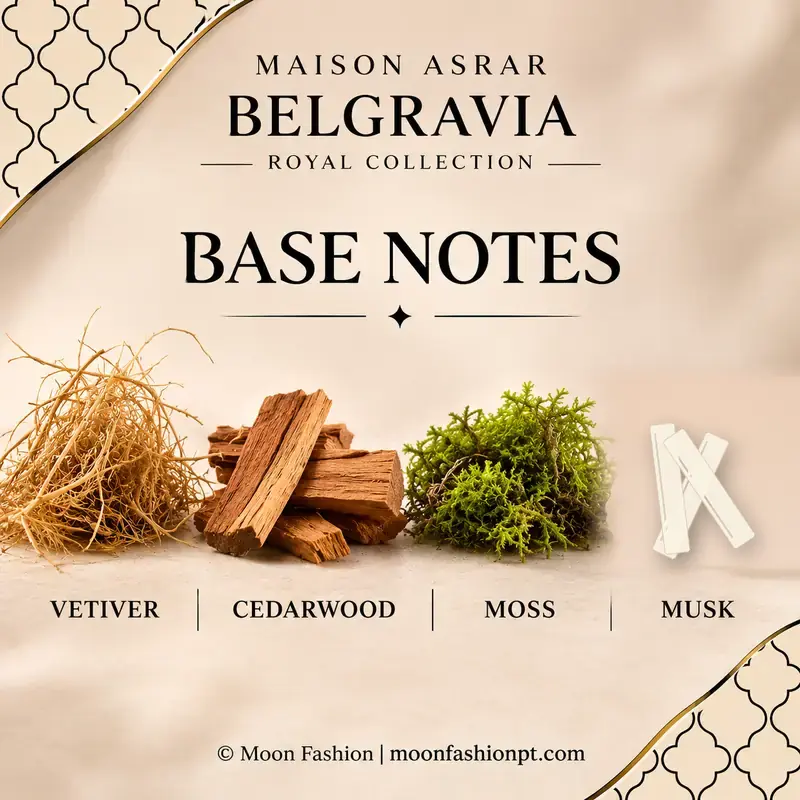
Base Note — Vetiver, Cedarwood, Moss, Musk
The official base contains three clearly wood- or earth-associated note references alongside musk. Their combination creates the main interpretive split in Belgravia: some people remember clean, soft musk; others notice a dry, green or earthy side. Both have a plausible connection to the listed base, but neither is universal.
What is the practical difference between clean and earthy here?
“Clean” in wearer language often points towards the softer, slightly powdery or skin-like impression associated with the musk facet. “Earthy” is a way some people describe the drier relationship between vetiver, cedarwood and moss. Those descriptions are not ingredients analyses, nor do they prove that the fragrance transforms identically for each person.
If you want the impression of a crisp, freshly laundered fabric from beginning to end, remember that Belgravia also contains a defined citrus introduction and a darker woody base. If you enjoy an understated shift from brightness to warmth, that contrast may be a strength rather than a drawback.
Does the powdery accord mean that the perfume will smell of talcum powder?
Not necessarily. Powdery is a specialist accord description and a quality reported by some wearers; talc is not named in Maison Asrar's official pyramid. A soft, matte or clean-feeling dry-down is a different expectation from a literal cosmetic powder scent. Other firsthand reports centre on moss or wood instead.
A useful personal test is to notice which memory stays with you after the floral phase: a smooth musk impression, a dry wood impression, or an interaction of both. The published ingredients terminology cannot replace that subjective check.
Can the base make Belgravia seem less sweet than the heart?
Yes, it may be perceived that way. Caramel belongs to the heart, while vetiver, cedarwood and moss form part of the subsequent listed foundation. The resulting contrast offers a reason for a seemingly creamy middle to lead towards a more restrained finish. It does not demonstrate that the caramel vanishes on a fixed schedule or that every wearer experiences less sweetness.
If you like the central creamy phase but dislike dry woods, this may be the point at which your opinion changes. If you value a fragrance that does not remain dessert-like, the same development may suit you. This is a product-specific preference decision, not a claim that either response is correct.
Deciding whether Belgravia fits how you wear fragrance
- Worth considering if
- You enjoy citrus that gives way to gentle flowers, a measured sweet accent and a woody-musky foundation.
- Worth testing first if
- You dislike sharp first sprays, need strongly noticeable caramel, or want your fragrance to remain purely fresh throughout wear.
- Important expectation
- Community accounts of projection and longevity do not agree; there is no substantiated wear-time promise.
Will Belgravia feel appropriate for everyday use?
Several wearer comments describe an easy-to-wear or clean quality, but that is experience-based guidance rather than a certified use case.
If you tend to choose discreet scents for work or shared spaces, evaluate how noticeable the citrus opening is and whether the later musky stage feels comfortable to you. A more noticeable first spray does not automatically mean the fragrance will project strongly all day.
Season labels are also shortcuts. Rather than assigning Belgravia to one temperature or occasion without systematic evidence, ask whether its bright-to-rounded contrast aligns with the setting and level of fragrance presence you prefer. A person seeking a gentle office scent may make a different decision from someone looking for a pronounced opening.
What do conflicting longevity and projection reports actually tell me?
They tell us to avoid converting anecdote into a specification. Some firsthand reviews find Belgravia relatively persistent or noticeable; others describe a smaller scent bubble or weaker wear. The evidence does not establish a representative average, and the Eau de Parfum designation does not establish exact hours.
Longevity and projection are separate questions. A person may still detect a scent on skin while someone nearby notices little diffusion. If either quality is central to your purchase, evaluate them separately in a realistic setting and remember that a single reviewer's spray count or comparison cannot forecast your own result.
There is also no sound reason to promise that storing the bottle for a set period will resolve an unsatisfactory opening or performance. Such claims are not established for this exact product.
What should I make of online comparisons with other perfumes?
Belgravia is discussed alongside Byredo Bal d'Afrique Absolu in specialist and community conversations. These accounts help explain why shoppers may be curious about its citrus-to-musk character, but they are not evidence of identical composition, guaranteed smell or interchangeable performance. Other reviewers note differences in brightness, sweetness and projection.
The more useful method is to compare observable preferences: do you like the citrus level in Belgravia, is its caramel effect sufficiently subtle or sufficiently apparent for you, and which side of its woody-musky finish do you notice? Those criteria remain meaningful even when the comparison perfume is unavailable.
The bottle, the presentation and a sensible buying check
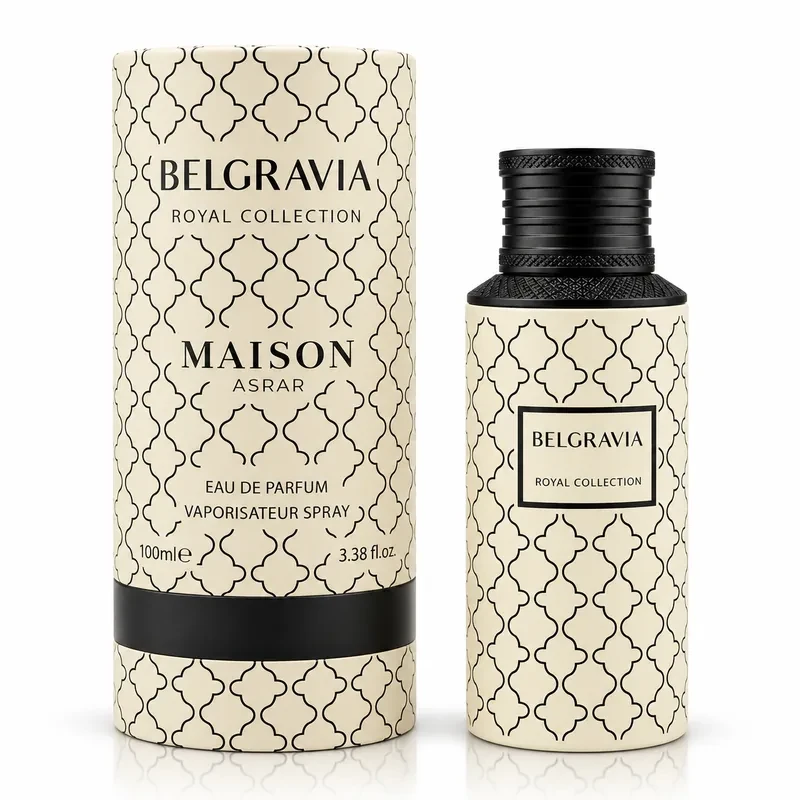
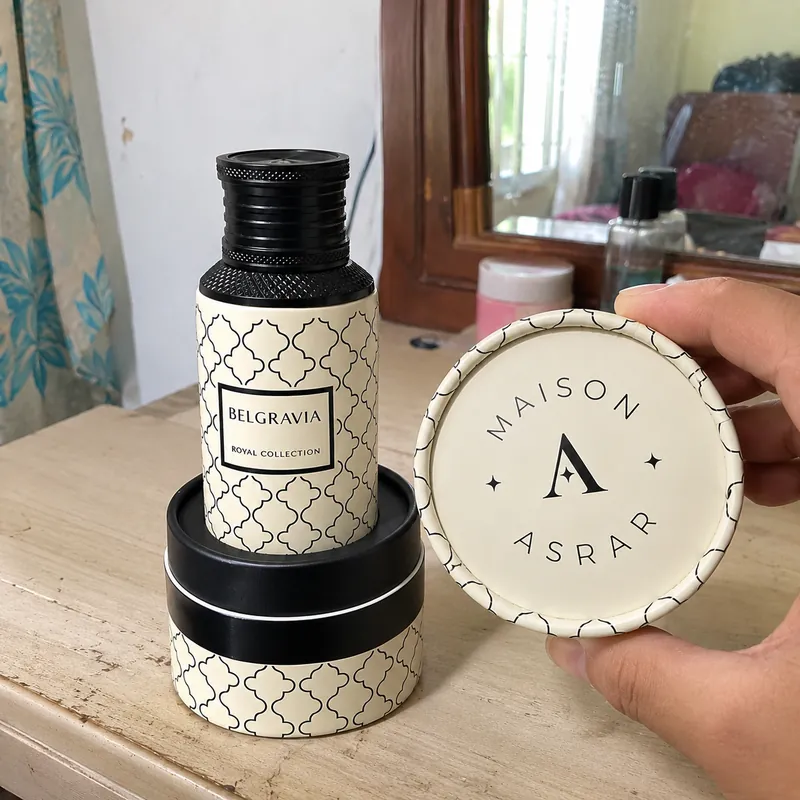
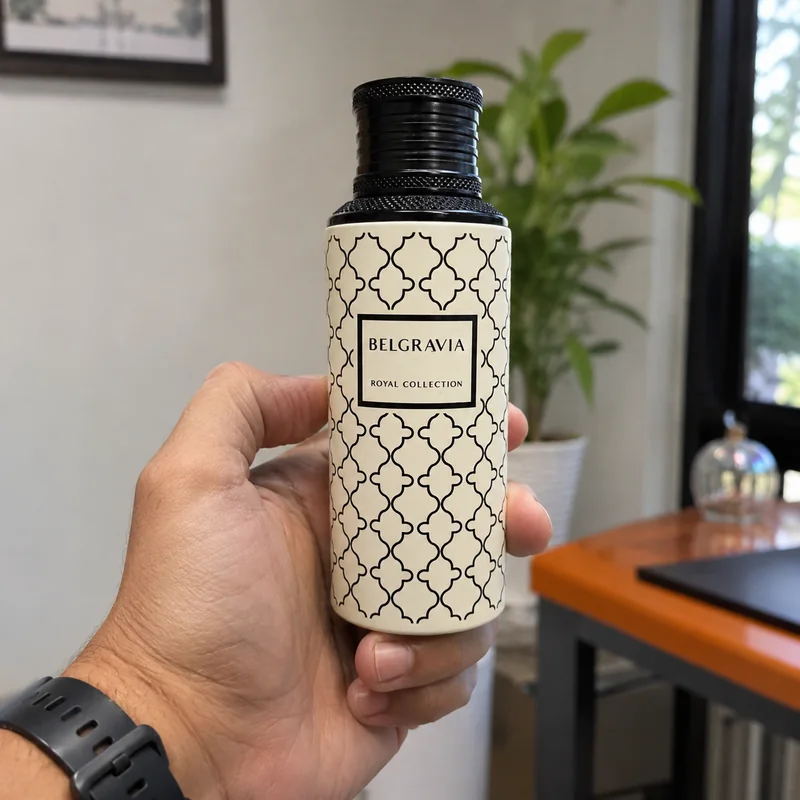
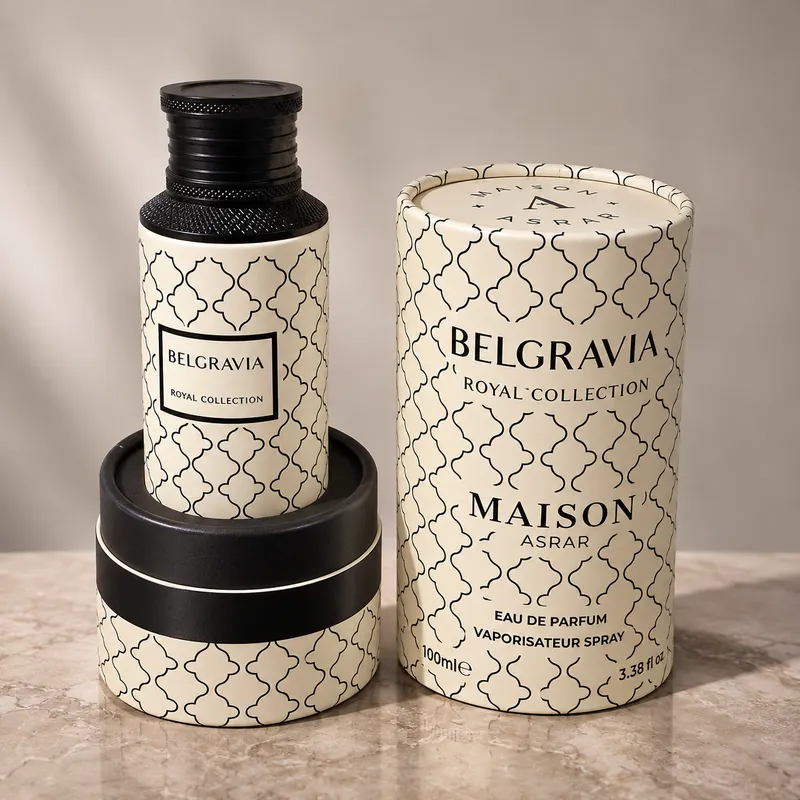
The photographed 100ml edition uses an ivory-toned bottle with a repeated black geometric motif, a ribbed black cap and a matching cylindrical Royal Collection package. These details help identify the pictured presentation. They do not, individually or together, certify a product's authenticity, and they should not be extrapolated to any unverified size.
Which checks matter most before ordering online?
Confirm the exact product name, concentration, selected volume and seller information. Review the actual product photographs and any applicable purchase conditions. Treat an identifier as a way to match a stated variant, not as proof of authenticity. Price, stock and delivery options are operational details to verify on the current product page rather than permanent scent characteristics.
If you are choosing between trying and buying a complete bottle, avoid assuming that a tester is available at Moon Fashion without confirmation. The safest useful advice is to check the real option offered, particularly if your decision depends on experiencing the divisive opening or variable woody-musk finish.
Can I check a Moon Fashion shop in Portugal?
Moon Fashion has physical shops in Portugal, but Belgravia and testers are not guaranteed at every location. Contact the relevant shop before making a product-specific journey and consult Moon Fashion store locations.
Consider Belgravia for the way its bright fruit-citrus opening makes room for a softer heart and a finish that can lean clean or earthy. Judge the entire progression, not just its first spray or its caramel note.
| Specifications | Descriptions |
|---|---|
| Brand | Maison Asrar |
| Collection / Line | Royal Collection |
| Product Name | Belgravia |
| Product Category | Perfume |
| Concentration | Eau de Parfum |
| Liquid Volume | 100ml |
| Target User | Unisex |
| Application Type | Spray |
| GTIN / EAN / UPC | 6290362166955 |
| Launch Year | 2026 |
| Main Accords | Citrus, Woody, Fruity, Aromatic, Floral, Powdery, Musky, Caramel |
| Longevity / Wear Experience | Varies between wearers; experiences are divided |
| Sillage / Projection Experience | Ranges from noticeable to close to the skin in wearer experiences |
| Top Notes | Bergamot, Blackcurrant, Lemon |
| Heart Notes | Lily of the Valley, Freesia, Sandalwood, Caramel |
| Base Note | Vetiver, Cedarwood, Moss, Musk |
| Bottle Design | Ivory bottle with black geometric pattern and ribbed black cap |
| Packaging Type | Cream and black geometric cylindrical outer box |
Latest Reviews
You May Also Like